I-PLAY Core Training: Inclusive Heritage Games for Educators (EN)

About Course
Welcome to the I-PLAY Core Training
I-PLAY is a European Erasmus+ Sport project (Proposal No. 101244092, February 2026 – July 2027) that brings traditional sports and games (TSG) back into schools, youth clubs and communities as tools for social inclusion, active lifestyles and living cultural heritage.
This free online course is the core training of the project. It is designed for teachers, PE instructors, youth workers, coaches, sports-club volunteers and community facilitators who want to use heritage games to include young people of every background, gender and ability.
Who builds I-PLAY
- ABARKA ONGD (Donostia / San Sebastián, Spain) – project coordinator, digital toolkit and online platform
- Biga Gelişim Spor Kulübü (Biga, Türkiye) – training curriculum, Train-the-Trainer and local sports festivals
- Association SEDA (Poland) – training needs assessment, quality assurance, evaluation and policy research
What you will learn
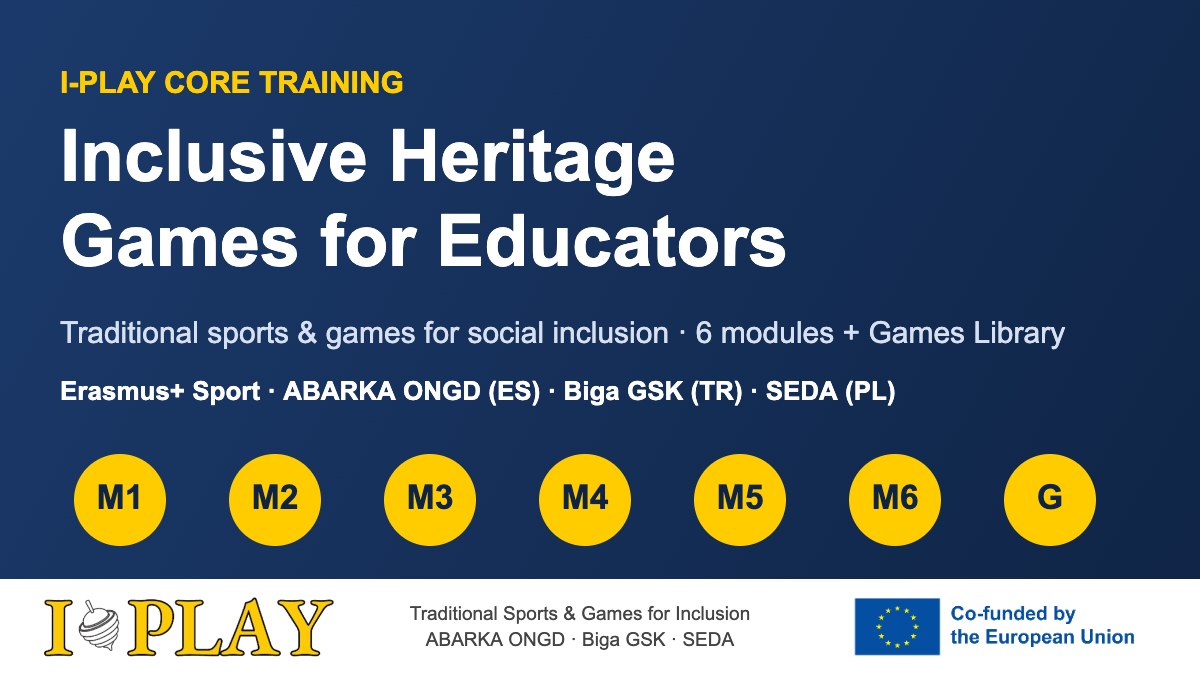
The course follows the I-PLAY Training Curriculum (six modules) and adds a practical Games Library:
- M1 · Introduction to Traditional Sports & Games – why heritage games matter today
- M2 · Rules & Safety Guidelines – running sessions safely and fairly
- M3 · Inclusive Adaptations for Marginalised Groups – adapting games for gender, disability, migrant and newcomer youth
- M4 · Community Engagement Strategies – families, schools, clubs and local festivals
- M5 · Practice & Peer Feedback – planning, delivering and reflecting on your own session
- M6 · Digital Tools & the I-PLAY Platform – using the digital toolkit and sharing your practice
- Games Library – 12 inclusive heritage games from Spain/Basque Country, Türkiye and Poland, with facilitation guidance
How the course works
- 28 lessons with practical examples from the project and video placeholders for game demonstrations
- 7 quizzes (pass mark 70%) – one at the end of each module
- 7 practical assignments – short tasks you apply in your own school, club or community
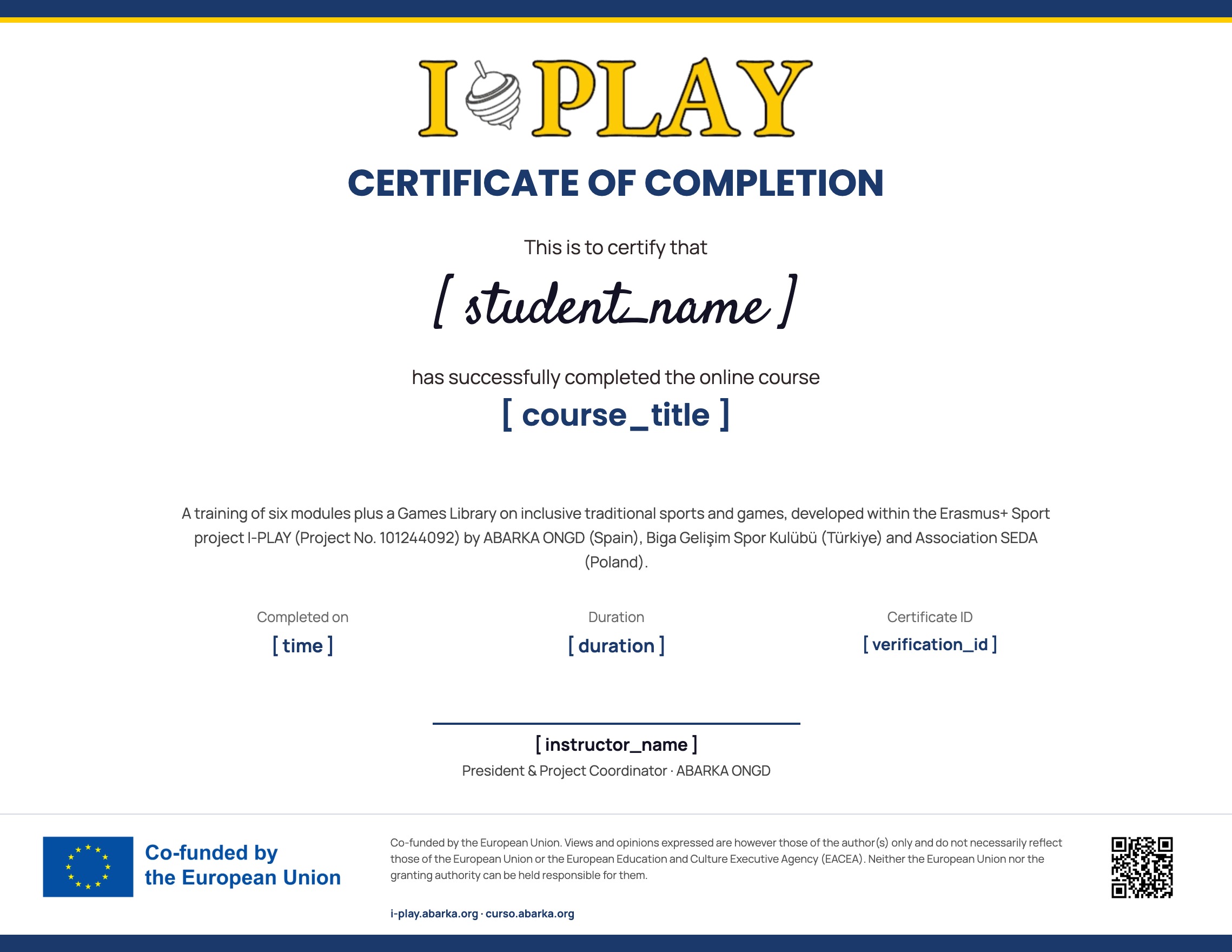
- Certificate of completion once all lessons, quizzes and assignments are completed
Estimated learning time: about 10–14 hours, self-paced. Spanish, Turkish and Polish versions are being prepared.
Co-funded by the European Union. Views and opinions expressed are however those of the author(s) only and do not necessarily reflect those of the European Union or the European Education and Culture Executive Agency (EACEA). Neither the European Union nor the granting authority can be held responsible for them.
Course Content
M1 · Introduction to Traditional Sports & Games
-
02:45
-
02:37
-
02:54
-
02:44
-
M1 Quiz · Traditional Games and Why They Matter
-
M1 Assignment · My Game Heritage Map and Pitch
M2 · Rules & Safety Guidelines
M3 · Inclusive Adaptations for Marginalised Groups
M4 · Community Engagement Strategies
M5 · Practice & Peer Feedback
M6 · Digital Tools & the I-PLAY Platform
Games Library · 12 Inclusive Heritage Games & Facilitation Toolkit
Obtén un certificado
Agrega este certificado a tu CV para demostrar tus habilidades y aumentar tus posibilidades de ser reconocid@.
Student Ratings & Reviews